Walk into almost any Australian workplace and you'll find a safety policy document, usually thorough, usually compliant, and usually filed away somewhere staff rarely look at unless an incident forces them to. The gap between having a safety policy and having a genuinely safe workplace is one of the most consistent patterns in workplace injury data and closing that gap tends to come down to a handful of practical, unglamorous habits rather than any single dramatic intervention.
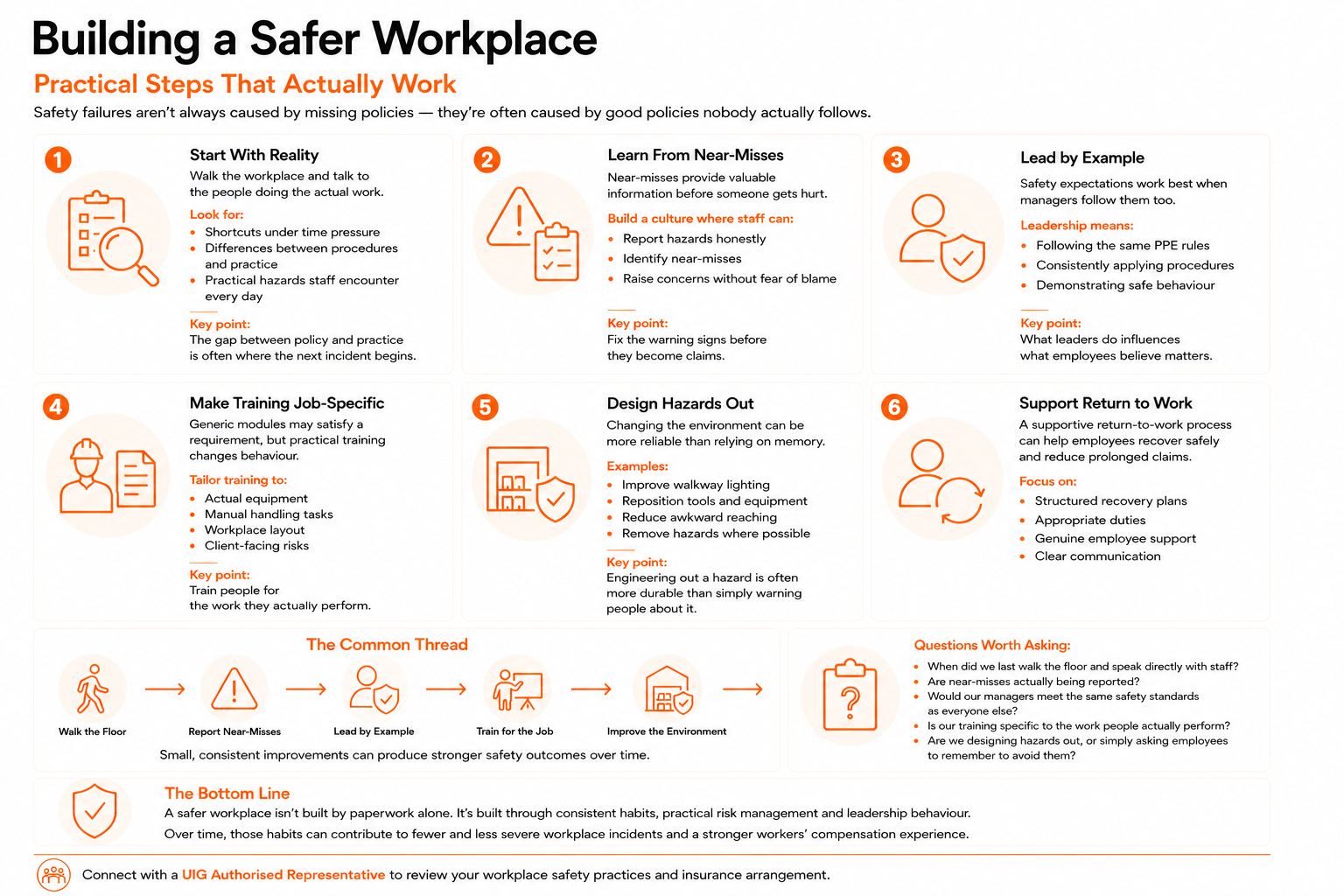
Start With What's Actually Happening, Not What's Written Down
The most useful safety audit isn't a review of the policy document it's a genuine walk through the workplace, talking to the people doing the actual work, and comparing what they describe doing against what the procedure says they should be doing. The gap between those two things is usually where the next incident is waiting.
This sounds simple, but it requires a specific kind of honesty that's easy to avoid: asking staff directly whether they ever take shortcuts under time pressure, and genuinely wanting to hear the answer rather than treating it as a compliance failure to be punished.
Near-Misses Are More Valuable Than Incidents
Most workplaces have a reasonably solid process for reporting actual injuries, because they're required to. Far fewer have a genuine culture of reporting near-misses the moments where something almost went wrong but didn't quite.
Near-misses are, in effect, free information about where your next actual incident is likely to come from, delivered before anyone gets hurt. A workplace where staff feel safe reporting near-misses without fear of blame will consistently identify and fix hazards earlier than one where near-misses go quietly unmentioned.
Make Safety a Leadership Behaviour, Not a Poster
Workplaces where managers and supervisors visibly follow the same safety rules they expect from everyone else see meaningfully better compliance than workplaces where safety is treated as something that applies to frontline staff but not leadership. If the safety glasses rule is enforced for the floor team but quietly ignored by the supervisor walking through, staff notice, and compliance erodes accordingly.
This is one of the lowest-cost, highest-impact interventions available: it requires no new equipment or budget, just consistent behaviour from the people staff are watching most closely.
Fit Training to the Actual Job, Not a Generic Module
Generic safety training satisfies a compliance requirement but often fails to change real behaviour, because it's not specific enough to the actual tasks, equipment, and layout of a particular workplace. Training built around the specific manual handling tasks, machinery, or client-facing risks your staff actually encounter tends to produce meaningfully better retention and application than a one-size-fits-all module completed once during onboarding and never revisited.
Fix the Environment, Not Just the Behaviour
Some of the most effective safety improvements involve changing the physical environment rather than relying on staff to remember a rule. Better lighting in a walkway reduces slip and trip risk more reliably than a sign asking people to watch their step. A properly positioned tool reduces awkward reaching more reliably than a reminder to "lift with your legs." Where possible, designing a hazard out of the environment is more durable than training people to work around it indefinitely.
Treat Return to Work as Part of Safety, Not an Afterthought
How an injury is managed after it happens has a meaningful effect on both the person's recovery and the ultimate cost and severity of the incident. A structured, genuinely supportive return-to-work process rather than one that feels adversarial or bureaucratic tends to produce faster, more complete recoveries, and reduces the likelihood of a minor injury turning into a prolonged claim.
The Common Thread
None of these steps require significant capital investment. They require consistency: genuinely walking the floor rather than reviewing a checklist, genuinely wanting to hear about near-misses rather than treating them as failures, and genuinely modelling the behaviour expected of everyone else. Workplaces that build these habits consistently see better safety outcomes over time than workplaces that simply have more thorough paperwork.
Want help reviewing your workplace safety practices against your current insurance arrangement? Connect with a UIG Authorised Representative.
A Realistic Example
A logistics business has a detailed, compliant manual handling policy that every new starter signs off on during induction. On the warehouse floor, however, staff routinely lift beyond the recommended limits during busy periods because the "correct" method takes longer and the workload doesn't adjust for it. Nobody flagged this as a problem because the policy technically existed and everyone had signed it. It takes a genuine floor walk and an honest conversation with the team rather than a review of the signed forms to surface the actual gap between policy and practice, and to start addressing the real cause: workload during peak periods, not staff carelessness.
Questions Worth Asking About Your Own Workplace
- When did we last walk the floor and ask staff directly whether they take shortcuts under time pressure and did we actually want to hear the answer?
- Are near-misses being reported honestly, or quietly absorbed without anyone finding out?
- Would our managers pass the same safety standard they expect from everyone else?
- Is our safety training built around what our people actually do, or is it a generic module completed once and forgotten?
- Are we trying to design hazards out of the environment, or just training people to remember to avoid them?
Safety improvements that last are rarely dramatic. They're the accumulation of small, consistent habits and they tend to show up, eventually, in a workers' compensation experience rating that reflects a genuinely lower-risk workplace.