Of all the questions brokers field from small business owners, few come up as often or get confused as consistently as the difference between public liability and professional indemnity insurance. Both are liability covers. Both protect a business against claims from someone else. And that's largely where the similarity ends.
Understanding the difference isn't just an academic exercise businesses that carry only one when they genuinely need both often discover the gap at the worst possible time: during a claim, when it's too late to add the missing cover.
Public Liability: Physical Injury and Property Damage
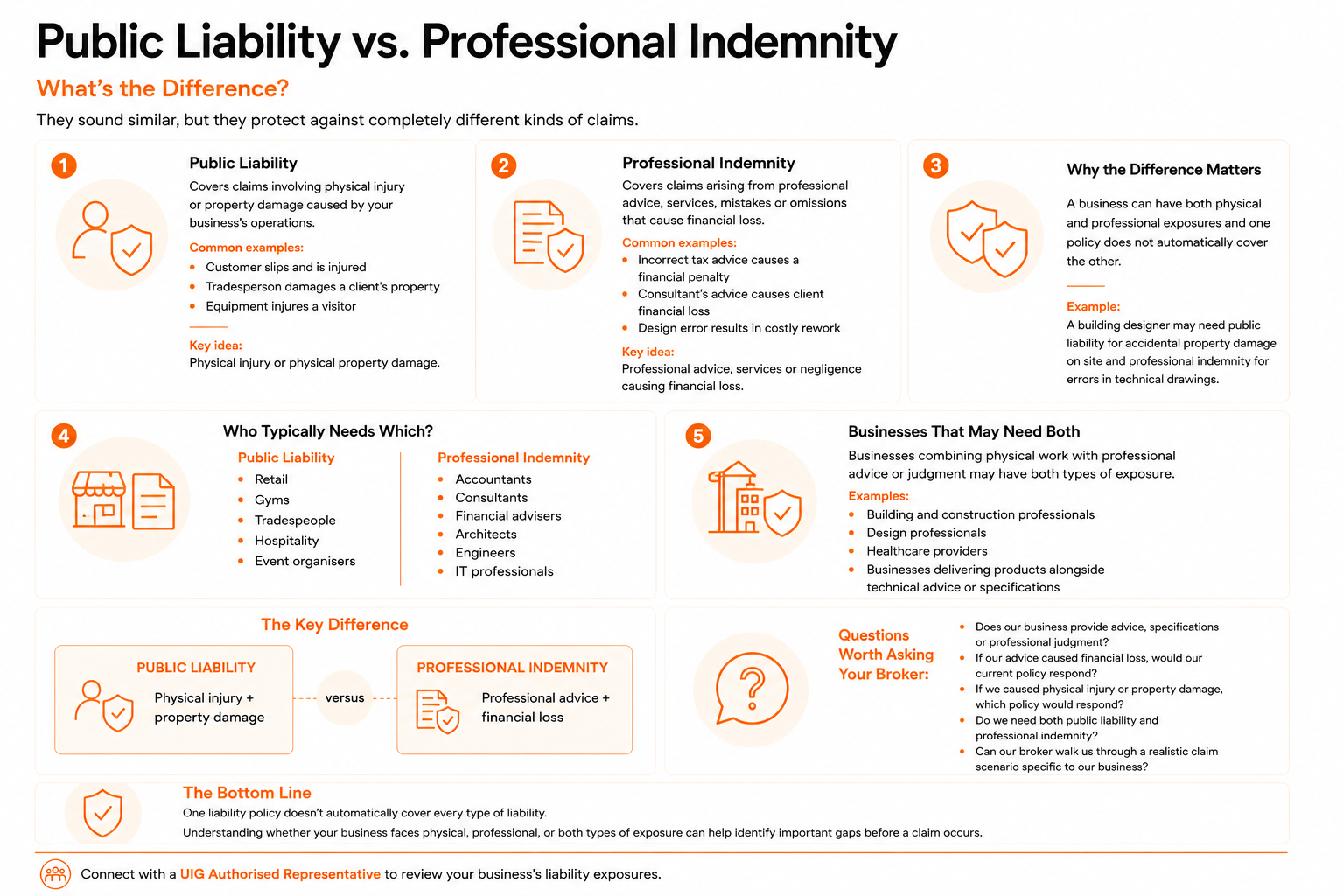
Public liability insurance covers your business against claims made by a third party typically a customer, client, or member of the public for physical injury or property damage caused by your business's operations.
Classic public liability scenarios include:
- A customer slips on a wet floor in your store and is injured
- A tradesperson accidentally damages a client's property while working on-site
- A piece of equipment at your business malfunctions and injures a visitor
The common thread across all of these: physical harm or physical damage, caused by something your business did in the physical world.
Professional Indemnity: Advice, Services, and Financial Loss
Professional indemnity insurance covers a completely different category of risk: claims arising from the advice, service, or professional work your business provided, where the claim is for
financial loss rather than physical injury or property damage.
Classic professional indemnity scenarios include:
- An accountant makes an error in a client's tax return, resulting in a financial penalty for the client
- A consultant provides advice that turns out to be negligent, causing a client financial loss
- A design professional's plans contain an error that leads to costly rework
Notice that none of these involve anyone being physically hurt or any physical property being damaged. The harm is purely financial, arising from a mistake, omission, or alleged negligence in professional work.
Why the Distinction Actually Matters
The confusion usually surfaces in businesses that provide both physical services and professional advice for example, a building designer who visits construction sites (physical exposure) but also produces technical drawings and specifications (professional exposure). A business like this genuinely needs both covers, because a single claim could fall entirely outside whichever one they don't carry.
It's also common for business owners to assume that because they carry public liability, they're broadly "covered for anything that goes wrong." In reality, a claim alleging that your advice was negligent with no physical injury or damage involved at all would typically not be covered by a public liability policy, regardless of how comprehensive it otherwise is.
Who Typically Needs Which Cover
Businesses that primarily need public liability tend to be those with regular physical interaction with customers or the public: retail stores, gyms, tradespeople, hospitality venues, and event organisers.
Businesses that primarily need professional indemnity tend to be those providing advice, expertise, or professional services: accountants, consultants, financial advisers, architects, engineers, and IT service providers.
Businesses that often need both include construction and building-related trades that combine physical site work with design or advisory components, healthcare providers who combine physical treatment with professional judgment, and any business that both delivers a physical product or service and provides advice or specifications as part of that delivery.
A Note on Overlap and Gaps
Insurers occasionally offer combined policies bundling elements of both covers, particularly for industries where the overlap is common and well understood but the specific inclusions still vary significantly between insurers and policies. The existence of a "combined" product doesn't guarantee comprehensive protection; it's still worth confirming exactly which scenarios are and aren't covered.
What to Ask Your Broker
If your business does anything beyond a single, clearly-defined activity if you give advice as well as perform physical work, or if your services blend into adjacent professional territory it's worth explicitly asking your broker: "if a claim arose from [specific scenario relevant to my business], which policy would actually respond, and am I covered for it at all?"
This is a more useful question than simply asking "am I covered," because it forces a concrete answer rather than a general reassurance.
Unsure which liability covers your business actually needs? Connect with a UIG Authorised Representative to review your specific risk profile.
A Realistic Example
A building designer visits a client's construction site regularly to inspect progress and also produces the technical drawings the builders work from. During one site visit, a piece of the designer's equipment is knocked over and damages a client's vehicle parked nearby a public liability claim, clearly. Separately, months later, a structural error is discovered in the drawings themselves, requiring costly rework a professional indemnity claim, just as clearly. Same business, same client relationship, two entirely different kinds of claims requiring two entirely different policies. A business carrying only one of these covers would have been left exposed on whichever claim fell outside it.
Questions Worth Asking About Your Own Business
- Does our business ever provide advice, specifications, or professional judgment as part of what we deliver even informally?
- If a client claimed financial loss because of a mistake in our advice or service, rather than a physical injury, would our current policy respond at all?
- Have we ever actually asked our broker to walk through a specific claim scenario relevant to our business, rather than accepting a general "yes, you're covered"?
- If our business does both physical work and professional advisory work, do we carry both public liability and professional indemnity, or just one?
- Would we know, without asking, which of our two most common types of claims exposure isn't currently covered at all?
The businesses that get caught out here are rarely negligent about insurance they simply assumed one broad-sounding policy covered a risk it was never designed to touch.