Marine and pleasurecraft insurance has a reputation for being straightforward: insure the hull, add some liability cover, and you're protected. In practice, this is one of the more nuanced areas of personal and commercial insurance, and the gaps that catch owners out are rarely in the parts of the policy they paid the most attention to.
As specialists in marine and pleasurecraft insurance, we see the same misunderstandings come up again and again here's what's genuinely worth knowing before you assume your cover has you fully protected.
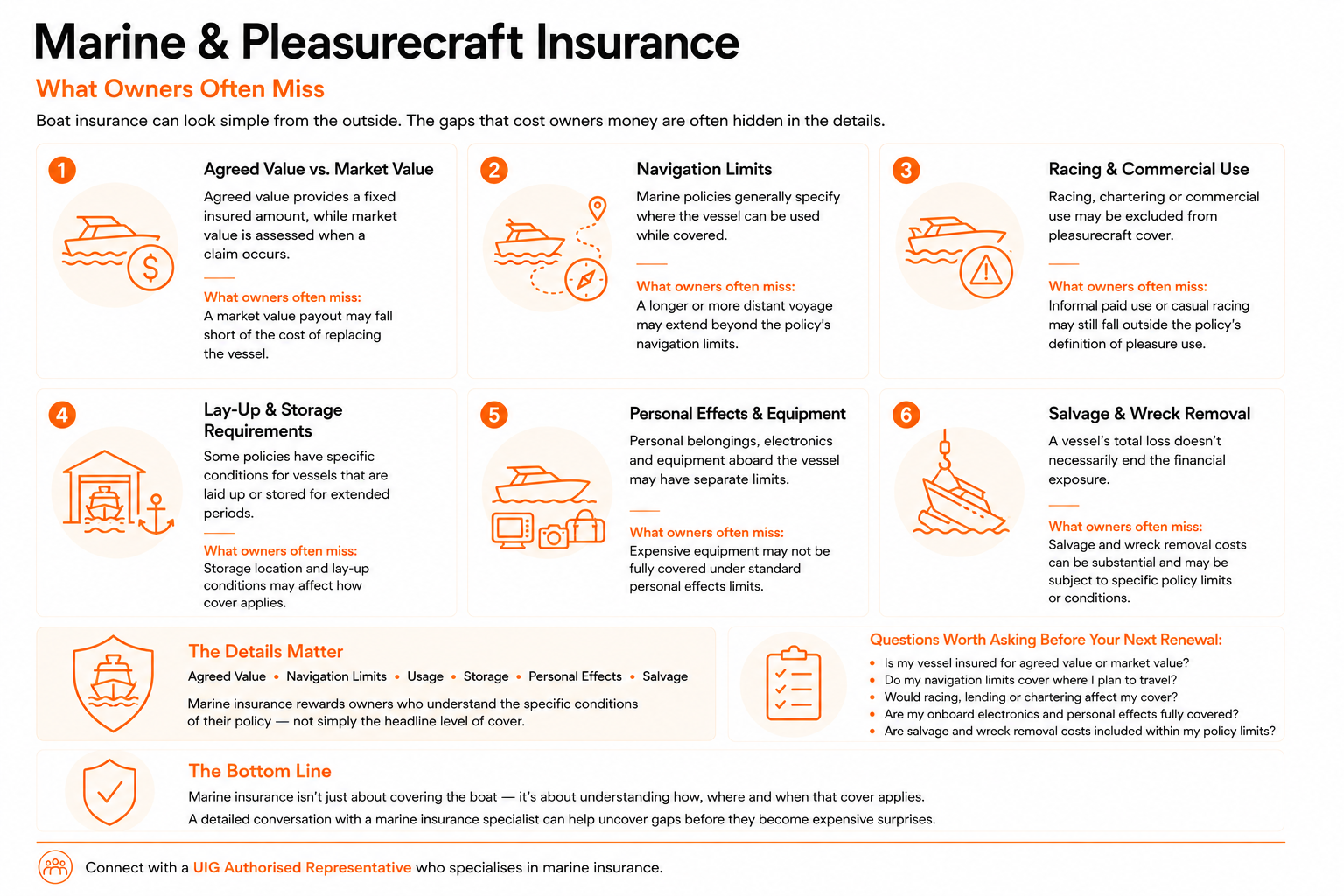
Agreed Value vs. Market Value
One of the most consequential decisions in a marine policy is whether your vessel is insured for an
agreed value or a
market value at the time of a claim.
An agreed value is fixed at the time the policy is arranged, giving certainty about exactly what you'll receive in the event of a total loss. A market value policy instead pays out based on the vessel's assessed value at the time of the claim which can be significantly lower than expected, particularly for vessels that have appreciated due to limited availability of a particular model, or that have had significant upgrades since the policy began.
What owners often miss: choosing market value to save on premium, without realising that the payout in a genuine total loss claim may fall well short of what it would actually cost to replace the vessel.
Navigation Limits and Geographic Restrictions
Most marine policies specify a navigation limit — the geographic area within which the vessel is covered. Venturing outside these limits, even briefly and even without incident, can affect a claim if something goes wrong during that time.
What owners often miss: planning a trip that extends beyond their usual cruising range further offshore, into different waters, or on an extended voyage without checking whether their existing navigation limits actually cover the new route.
Racing, Chartering, and Commercial Use Exclusions
Many pleasurecraft policies explicitly exclude cover while the vessel is being used for racing, chartering to third parties, or any commercial purpose even if that use is occasional or informal.
What owners often miss: lending or informally chartering their vessel to friends or family for a fee, or entering a casual local race, without realising this may fall outside their policy's definition of pleasure use.
Lay-Up Periods and Storage Requirements
Some marine policies include specific requirements or reduced premiums for periods when a vessel is laid up (not in use) often over winter months or extended periods of non-use but these provisions sometimes come with conditions about how and where the vessel must be stored during that period.
What owners often miss: assuming a vessel is automatically covered in storage the same way it's covered while in use, without confirming whether specific lay-up conditions apply.
Personal Effects and Equipment Aboard
Many owners assume that personal belongings, electronics, and equipment kept aboard a vessel are automatically covered under the hull policy. In practice, personal effects cover is often a separate, sometimes optional component with its own sub-limits meaning a full loss of expensive equipment or personal items may only be partially reimbursed, even if the vessel itself is fully covered.
What owners often miss: keeping high-value equipment or electronics aboard without checking whether personal effects cover and its sub-limits actually extends to the full value of what's on the vessel.
Salvage and Wreck Removal
If a vessel sinks or is significantly damaged, the cost of salvage or wreck removal can be substantial and in some jurisdictions, owners can be legally required to remove a wreck regardless of whether they intend to make an insurance claim for the vessel itself.
What owners often miss: assuming that if a total loss claim is paid out, that's the end of the financial exposure without checking whether salvage and wreck removal costs are included within the same policy limits or covered separately.
What This Means for Owners
None of these gaps are unusual or the result of a poorly designed policy they're simply areas where marine insurance requires more specific, informed conversations than a standard "get a quote" transaction typically involves. An owner who has never actually discussed navigation limits, agreed value, or personal effects sub-limits with their broker may be operating under assumptions about their cover that don't match the actual policy wording.
What to Ask Your Broker
Before your next renewal, it's worth explicitly confirming: is my vessel insured for agreed or market value, and do I understand the difference in a real claim scenario? Do my navigation limits actually cover where I plan to use the vessel this year? Would any informal chartering or racing use void my cover? And are salvage and wreck removal costs included within my policy limits, or would they be an additional, uninsured cost?
Have questions about your marine or pleasurecraft policy? Connect with a UIG Authorised Representative who specialises in marine insurance.
A Realistic Example
An owner insures their vessel for market value to save on premium, reasoning that the boat is a few years old and depreciating anyway. Two years later, a total loss claim reveals the opposite has happened the specific model has become harder to find secondhand, and market value has actually risen above what the owner originally paid. The market value payout, based on a formal valuation at time of loss, falls well short of what it now costs to buy an equivalent replacement vessel. The owner had assumed depreciation was a one-way street; for that particular model, it wasn't.
Questions Worth Asking Before Your Next Renewal
- Is our vessel insured for agreed value or market value, and do we understand what that actually means if the worst happens?
- Do our navigation limits genuinely cover where we plan to take the vessel this season, including any longer trips?
- Have we ever lent, chartered, or raced the vessel informally, and would that fall outside our policy's definition of pleasure use?
- Does our personal effects cover actually extend to the full value of the equipment and electronics we keep aboard?
- If the vessel were a total loss, are salvage and wreck removal costs included in our policy limits, or would that be a separate, uninsured cost?
Marine insurance rewards owners who ask specific questions rather than assuming a policy behaves the way common sense suggests it should. The gaps above are rarely anyone's fault they're simply the kind of detail that only surfaces in a proper conversation with a broker who actually specialises in this area.