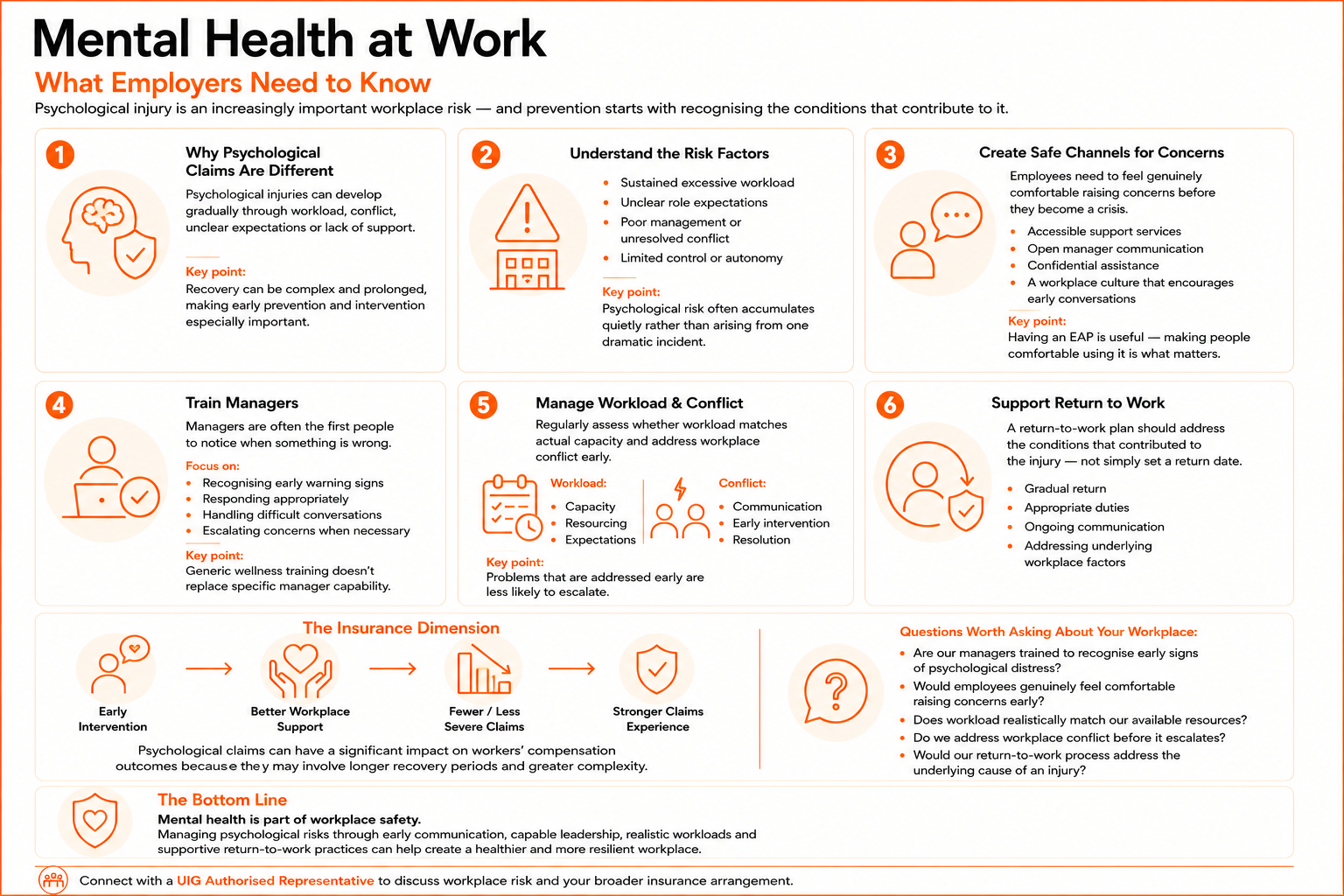
For decades, workplace safety conversations focused almost entirely on physical risk: manual handling, machinery, slips and falls. That focus made sense when physical injury represented the overwhelming majority of workplace claims. It no longer reflects the full picture. Psychological injury claims relating to stress, workplace conflict, bullying, and burnout now represents a significant and steadily growing share of workers' compensation claims across Australian industries, and they tend to be more costly and longer-running than the average physical claim.
Despite this shift, many employers still approach mental health as a personal matter for staff to manage privately, rather than a genuine workplace risk to be actively managed. That gap in approach is where most of the avoidable cost and harm accumulates.
Why Psychological Claims Are Different
A physical injury usually has a clear cause, a defined treatment path, and a reasonably predictable recovery timeline. Psychological injury is often none of these things. The cause may be a single incident or, more commonly, an accumulation of factors over months excessive workload, unresolved conflict, unclear expectations, or a lack of support during a difficult period. Recovery timelines vary significantly, and a poorly managed return to the same unaddressed conditions that caused the injury in the first place frequently leads to relapse.
This complexity is exactly why psychological claims tend to run longer and cost more than the average physical claim and why prevention is significantly more valuable than response, in ways that don't always apply as clearly to physical safety.
Common Risk Factors Worth Understanding
Certain workplace conditions are consistently associated with higher psychological injury risk: sustained excessive workload without corresponding support or resourcing; unclear role expectations that leave staff uncertain what's actually required of them; poor management practices, including inconsistent feedback or unaddressed interpersonal conflict; and a lack of control or autonomy in how work gets done.
None of these require a single dramatic incident to cause harm they accumulate quietly, often for months, before surfacing as a formal claim or a sudden, unexplained resignation.
What Employers Can Actually Do
Build genuine channels for raising concerns early. Many workplaces have an Employee Assistance Program listed in an onboarding pack, but far fewer have a culture where staff feel genuinely comfortable raising a concern to their direct manager before it escalates. The existence of a support service matters less than whether people actually feel safe using it.
Train managers specifically, not just staff generally. Frontline and middle managers are often the first point of contact when something is going wrong, and yet rarely receive specific training in recognising early signs of psychological distress or responding appropriately. Generic staff wellness training doesn't substitute for this.
Monitor workload realistically, not just on paper. A role description that looks reasonable on paper can become unsustainable in practice if resourcing hasn't kept pace with actual demand. Regularly and honestly checking whether workload matches capacity rather than assuming it does because nobody has formally complained catches problems earlier.
Address conflict directly rather than letting it linger. Unresolved interpersonal conflict is one of the most consistent contributors to psychological injury claims, and it rarely resolves itself by being ignored. Early, direct intervention is uncomfortable but almost always less costly than a prolonged, unaddressed situation.
Support genuine, gradual return to work. Where a psychological injury claim does occur, a return-to-work plan that addresses the underlying conditions that contributed to the injury not just a timeline for returning to the same desk significantly reduces the risk of relapse.
The Insurance Dimension
Because psychological injury claims tend to be more complex and longer-running, they have a disproportionate effect on a business's overall claims experience relative to their frequency. A business that proactively manages psychological risk through genuine early intervention, manager training, and realistic workload management is likely to see this reflected over time in its broader workers' compensation experience, in the same way that physical safety investment gradually shapes an experience rating.
Where to Start
For many businesses, the most useful first step isn't a new policy document it's an honest internal conversation about whether staff would actually feel comfortable raising a concern before it became a crisis, and whether managers currently have the training and confidence to respond well if they did.
Want to talk through how workplace mental health risk factors into your broader insurance arrangement? Connect with a UIG Authorised Representative.
A Realistic Example
An employee's performance quietly declines over several months amid a sustained period of understaffing on their team. No single incident triggers concern the workload simply keeps increasing while support doesn't. Eventually the employee takes an extended stress leave, and the resulting claim takes considerably longer to resolve than a comparable physical injury would have, partly because there's no single clear cause to point to and partly because the underlying conditions the understaffing hadn't been addressed even after the claim began. A return-to-work plan focused only on a phased return to the same desk, without addressing the resourcing gap that caused the problem, risks the same outcome recurring.
Questions Worth Asking About Your Own Workplace
- Do our managers have specific training in recognising early signs of psychological distress, or only generic wellness training aimed at staff?
- Would someone on our team feel genuinely comfortable raising a workload or conflict concern before it became a crisis?
- Do we check whether workload realistically matches resourcing, or only respond once someone formally complains?
- When conflict arises between staff, do we address it directly and early, or let it linger until it becomes unavoidable?
- If a psychological injury claim occurred, would our return-to-work plan address the underlying cause, or just the timeline for returning to work?
Mental health at work isn't a separate category from workplace safety it's an extension of the same risk management thinking that's long been applied to physical hazards, just applied to a type of risk that's less visible and, increasingly, more costly to ignore.