Since 2020, flexible and hybrid work arrangements have become a permanent feature of the Australian workplace rather than a temporary exception. What's had far less attention is how significantly this shift has changed some of the assumptions underlying workers' compensation, business insurance, and workplace safety obligations assumptions that many businesses haven't fully revisited, even years into arrangements that are now simply how they operate.
Workers' Compensation Still Applies at Home
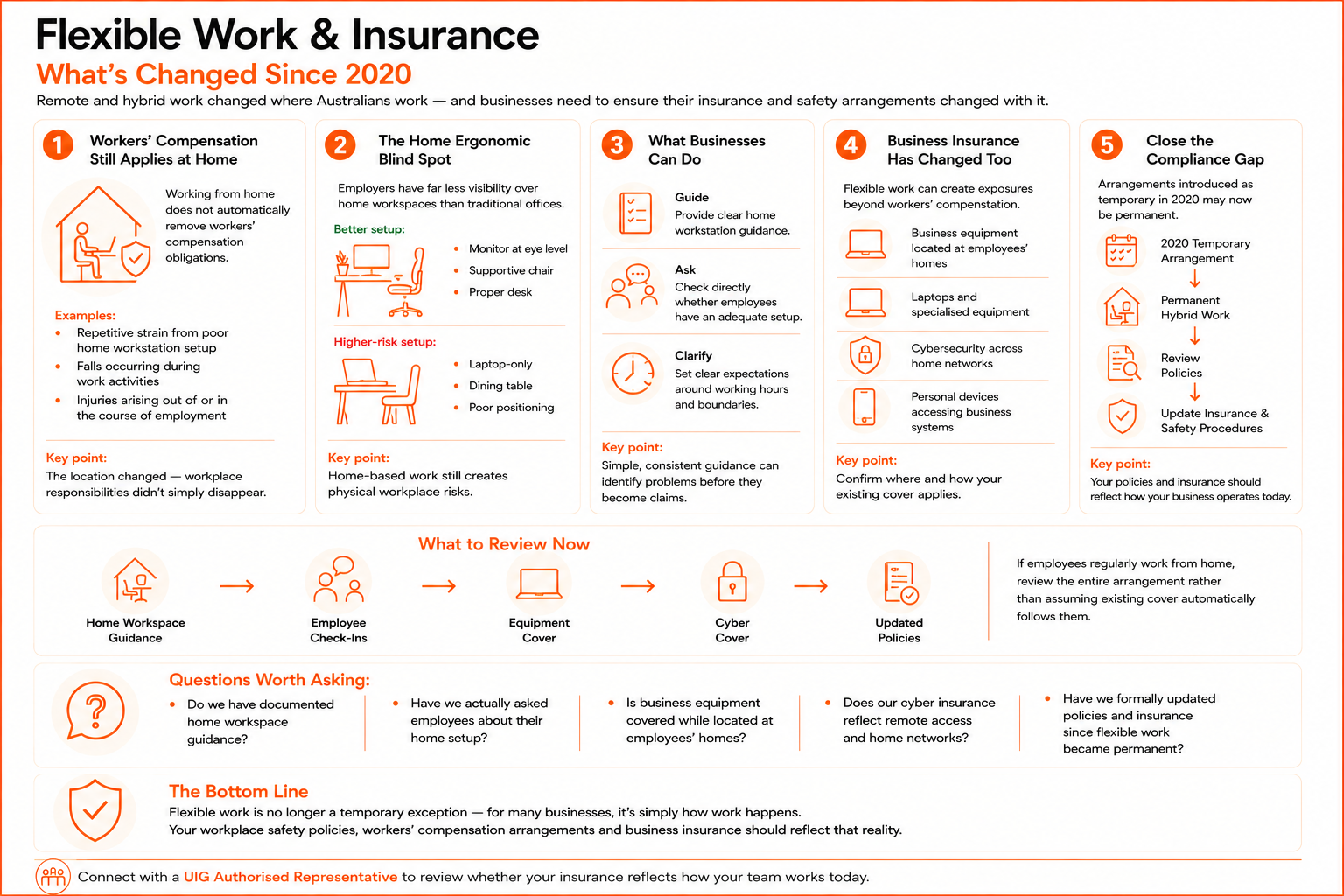
One of the most persistent misunderstandings about remote work is the assumption that workers' compensation obligations somehow lessen when an employee is working from their kitchen table rather than an office. In reality, an employer's duty of care and workers' compensation obligations generally extend to an employee's home workspace in much the same way they apply to a traditional office, provided the injury arises out of or in the course of their employment.
This means a repetitive strain injury developed from a poorly set up home desk, or a fall while retrieving a work laptop from another room during work hours, can potentially constitute a legitimate workers' compensation claim an outcome that surprises many employers who assumed home-based work fell outside their responsibility.
The New Ergonomic Blind Spot
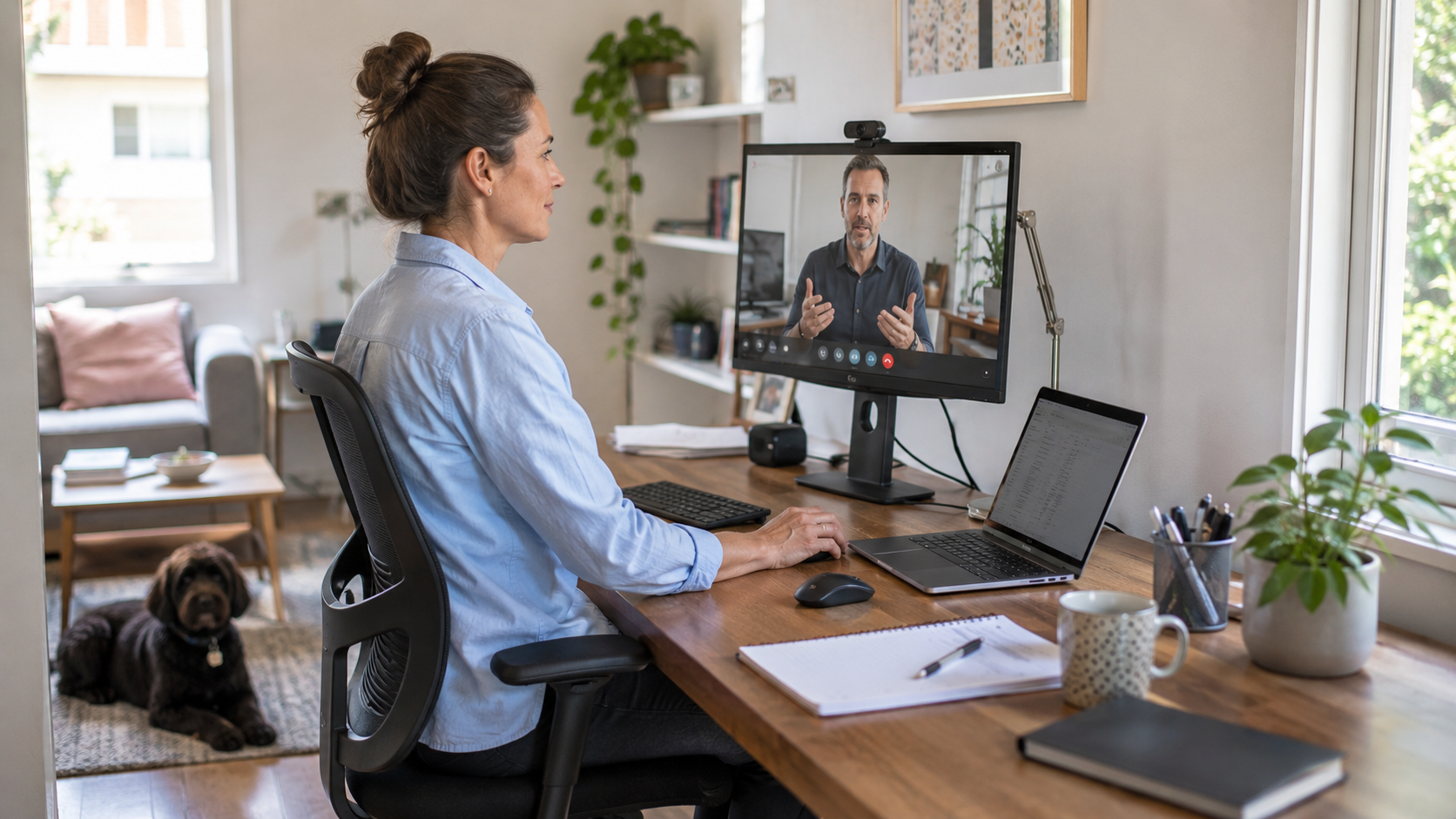
Office-based ergonomic assessments are relatively straightforward to conduct and standardise. Home workspaces are far more variable, and far less visible to an employer. An employee working from a proper desk with an adjustable chair presents very different risk to one working from a dining table and a laptop balanced on a stack of books and many businesses have limited visibility into which scenario actually applies to any given team member.
This has created a genuine ergonomic blind spot: the physical risk hasn't disappeared just because it's no longer happening in an office the employer directly controls.
What Businesses Can Reasonably Do
Provide basic home workspace guidance, covering monitor height, chair support, and desk setup, even for staff working from home only occasionally. This doesn't need to be elaborate to be useful clear, practical guidance is far better than no guidance at all.
Ask directly, rather than assuming. A simple, genuine check-in about whether a team member's home setup is adequate surfaces problems that would otherwise remain invisible until an injury occurs.
Clarify expectations around work hours and boundaries. Blurred boundaries between work and personal time in a home environment have been linked to increased stress-related claims, making clear expectations around availability and hours a genuine risk factor worth addressing directly, not just a wellbeing nicety.
Business Insurance Considerations Beyond Workers' Compensation
Flexible work has also raised less obvious questions for broader business insurance. Does your business insurance extend to equipment — laptops, monitors, specialised tools while it's located at an employee's home rather than your business premises? Does your cyber insurance adequately account for a workforce accessing business systems from a wider range of personal networks and devices, rather than a controlled office network? These are worth explicitly confirming rather than assuming existing cover automatically extends to cover a genuinely different working arrangement than the one the policy may have originally been designed around.
The Compliance Gap Many Businesses Haven't Closed
A significant number of businesses adopted flexible work arrangements rapidly, as a necessary response to changing circumstances, without fully revisiting their safety policies, insurance arrangements, or workers' compensation obligations to reflect the new reality. Years later, many of these arrangements have become permanent, while the underlying policies and cover have not been formally updated to match.
This is worth treating as a genuine compliance and cover gap, not a minor administrative oversight particularly as the arrangements originally treated as temporary have, in many businesses, quietly become the permanent way of working.
What to Review Now
If your business has staff working from home on any regular basis, it's worth explicitly confirming: do we have any documented home workspace guidance? Have we asked staff directly about their home setup, rather than assuming it's adequate? Does our business insurance and cyber insurance genuinely reflect how and where our team actually works today, rather than how they worked when the policy was first arranged?
Want to review whether your insurance arrangement reflects how your team actually works today? Connect with a UIG Authorised Representative.
A Realistic Example
An employee working from home develops a repetitive strain injury in their wrist over several months, using a laptop without an external keyboard or proper desk setup. When the claim is lodged, the employer is surprised to learn that the injury is a legitimate workers' compensation matter despite happening entirely at the employee's home, with no employer visibility into the setup at any point. No home workspace guidance had ever been issued, and no one had asked the employee directly whether their setup was adequate the arrangement had simply been adopted quickly in 2020 and never formally revisited since.
Questions Worth Asking About Your Own Workplace
- Do we have documented home workspace guidance, or did our flexible work arrangement begin without ever formalising expectations?
- Have we asked staff directly about their home setup, or are we assuming it's adequate because no one has complained?
- Does our business insurance clearly extend to equipment located at employees' homes, or does that fall into a grey area we've never confirmed?
- Does our cyber insurance genuinely account for staff accessing systems from home networks and personal devices?
- If our flexible work arrangement started as a temporary response years ago, have we ever gone back and formally updated our policies and cover to reflect that it's now permanent?
Flexible work isn't a temporary exception anymore for most businesses it's simply how work happens. The insurance and safety framework around it deserves the same permanent status, rather than remaining an unrevisited holdover from an arrangement that was only ever meant to be short-term.