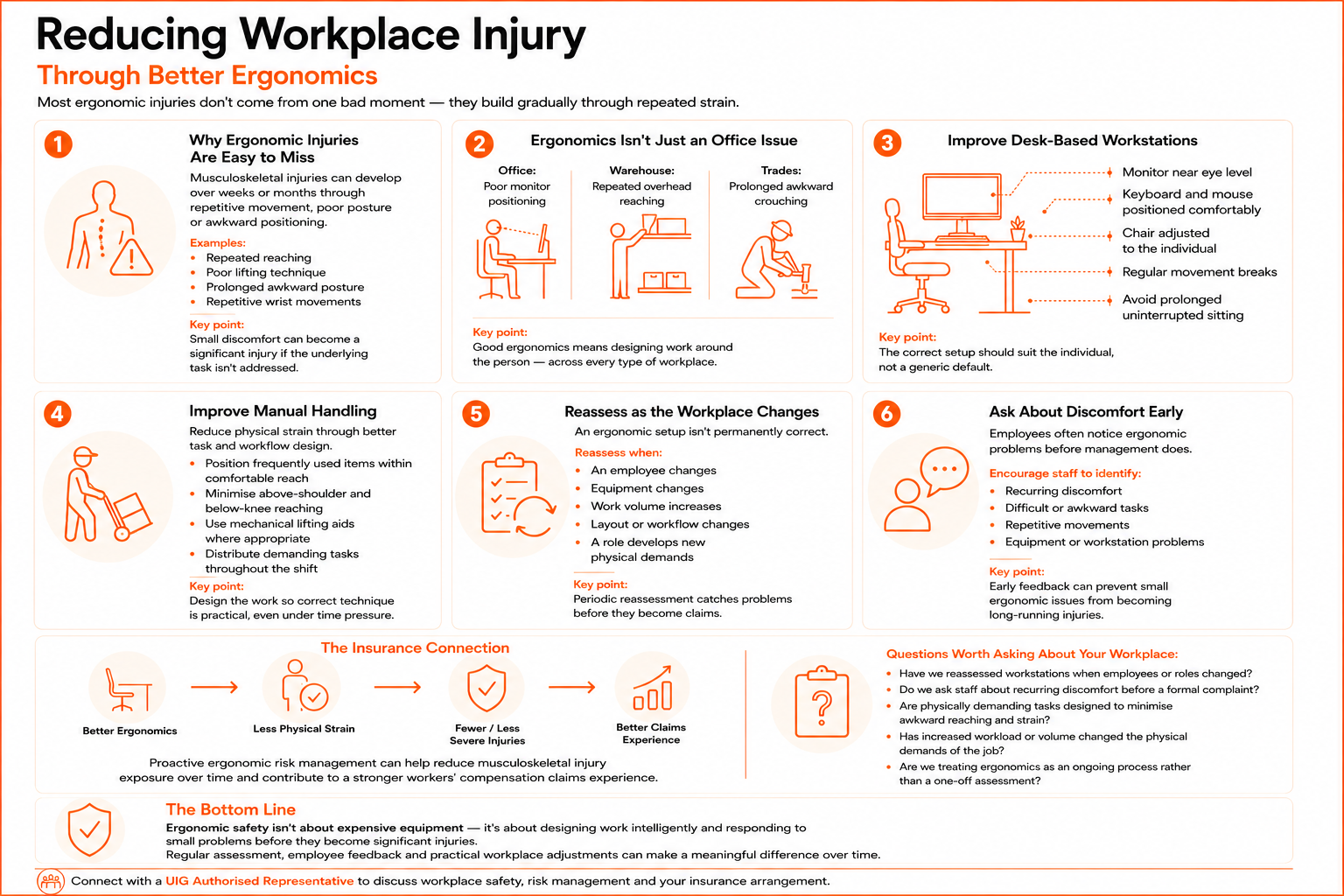
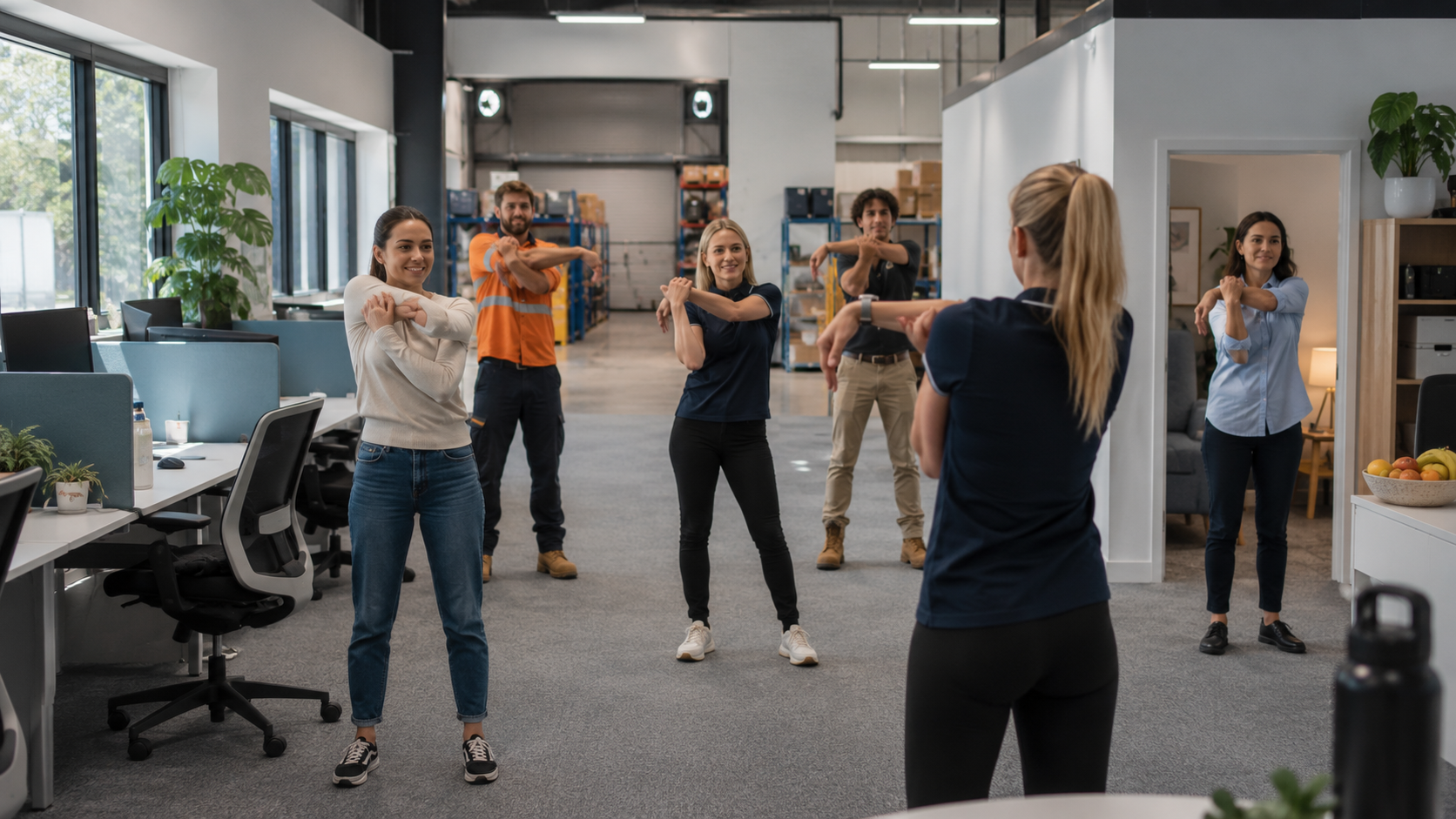
Workplace ergonomics has a branding problem: it sounds like a topic about fancy office chairs, when in reality it's one of the more significant and consistently underestimated drivers of workplace injury claims across almost every industry, not just desk-based ones. Ergonomic injuries musculoskeletal strain from repetitive movement, poor posture, or awkward positioning tend to develop gradually, which makes them easy to overlook until they've become a genuine, sometimes long-running claim.
Why Ergonomic Injuries Are Easy to Miss
Unlike a slip, trip, or acute injury with a clear moment of occurrence, ergonomic injuries typically develop over weeks or months of repeated strain a shoulder that gradually worsens from months of reaching, a lower back that deteriorates from months of poor lifting technique, wrists that develop repetitive strain from thousands of small movements. Because there's rarely a single identifiable incident, these injuries are often under-reported in their early stages, surfacing only once they've become serious enough to force time off work.
This gradual development is exactly why ergonomic risk deserves proactive attention rather than a reactive response after an injury has already progressed.
It's Not Just an Office Problem
Ergonomics is often associated narrowly with desk setups, but the underlying principle positioning the work to suit the person, rather than forcing the person to adapt to poorly designed work applies just as much to physical and industrial roles. A warehouse worker repeatedly reaching above shoulder height to retrieve stock, a tradesperson working in a consistently awkward crouched position, and an office worker with a poorly positioned monitor are all experiencing the same underlying category of risk, just in different physical contexts.
Practical Improvements That Actually Help
For desk-based roles: monitor height at eye level, keyboard and mouse positioned to avoid wrist strain, chair support matched to the individual rather than a generic default setting, and regular movement breaks rather than long uninterrupted sitting periods.
For roles involving manual handling: equipment and shelving positioned to minimise reaching above shoulder height or below knee height, mechanical lifting aids provided where repetitive heavy lifting is unavoidable, and workflow design that distributes physically demanding tasks across a shift rather than concentrating them.
For any repetitive task: task rotation to avoid the same muscle groups being strained continuously throughout a shift, and genuine attention to whether a task's pace allows for correct technique, or whether time pressure is quietly encouraging shortcuts that increase strain.
The Assessment Gap
Many businesses that do invest in ergonomic assessments make the same mistake: they conduct a single assessment when a role is first set up, then never revisit it as the role, equipment, or person changes. An ergonomic setup that suited one employee may not suit their replacement. A workflow that was reasonable when a business was smaller may have quietly become unsustainable as volume increased without a corresponding adjustment to layout or process.
Ergonomic risk deserves periodic reassessment, not a single one-off review treated as permanently sufficient.
Why This Connects to Insurance
Musculoskeletal injuries arising from poor ergonomics are a significant and recurring driver of workers' compensation claims, and they tend to have longer recovery periods than many acute physical injuries, because they often involve chronic strain rather than a single, clearly resolved injury. A business that proactively addresses ergonomic risk through practical adjustments and periodic reassessment is likely to see this reflected over time in fewer and less severe musculoskeletal claims, contributing to a more favourable claims experience.
Getting Started Without Overcomplicating It
Effective ergonomic improvement doesn't require an expensive external consultant for every workplace. Often, the most valuable step is simply asking staff directly whether any part of their role causes recurring discomfort, and taking that feedback seriously rather than assuming existing setups are adequate because no one has formally complained. Combined with periodic reassessment as roles and equipment change, this practical, ongoing attention tends to catch problems well before they become a claim.
Want to talk through how ergonomic risk factors into your broader safety and insurance approach? Connect with a UIG Authorised Representative.
A Realistic Example
An administrative role is set up for one employee, with a desk and monitor arranged to suit their height and preferences. Two years later, a new, considerably taller employee takes over the same role, using the same unchanged desk setup, because nobody thought to reassess it during handover. Over several months, the new employee develops recurring neck and shoulder strain from constantly looking down at a monitor positioned too low a slow, cumulative injury that could have been avoided with a simple reassessment at the point the role changed hands, rather than assuming the existing setup was universally fine.
Questions Worth Asking About Your Own Workplace
- Have we reassessed ergonomic setups when roles changed hands, or are we assuming a setup designed for one person suits everyone who follows?
- Do we ask staff directly whether any part of their role causes recurring discomfort, or wait for a formal complaint before addressing it?
- For physically demanding roles, is work positioned to minimise awkward reaching and repetitive strain, or does the task shape itself around whatever's convenient to set up?
- Has our workflow or volume changed since we last considered whether the physical layout still makes sense?
- Are we treating ergonomic risk as a one-off setup task, or as something that deserves periodic attention as the business changes?
Ergonomic injuries rarely announce themselves clearly. The businesses that manage this risk well are the ones willing to ask about small, recurring discomfort before it becomes a genuine claim not after.